Showing posts with label vintage. Show all posts

Thursday, 31 July 2014

Restoring a Vintage Lens

As well as the usual souvenirs and peppermint rock, a recent trip to the seaside yielded something much more worthwhile. While frittering away the dog-end of the afternoon browsing in a back-street junk shop, I came across a battered old brass lens.


Here it is, screwed onto a home-made lens board. I did it so my students could use it to experiment with paper negatives in a 5"x4" camera. I thought it might be from an old projector or magic lantern, given that it had a fixed aperture, no shutter mechanism and was focused by a rack-and-pinion. The only thing that made me doubt this assumption was that it had a lens hood (removed in the above photo) – not something you would expect on a lens where the light comes out of the lens, rather than going in.


The main problem with the lens was that the focusing spindle was badly bent so that the pinion teeth didn't properly mate with the teeth on the rack, which meant that it couldn't be reliably focused. Given it was in such poor condition and had cost me next to nothing, it seemed like it might be fun to try and get it back into better order.


Needless to say, the lens came apart pretty easily. A lens like this is a classic example of form and function co-existing in simple harmony, the function of each part being evident by its appearance. There are only six screws in all, four holding the pinion against the rack with two more keeping the rack in place. Other than that, the individual components go together by screwing one into another.


The first task was to clean off the accumulated grime and corrosion. While serious collectors have strong views on what should or shouldn't be done, my interest is in the lens's functionality rather than its collect-ability. Vinegar seemed to do a good job of tackling corrosion, while regular paint stripper brought off dirty and discoloured lacquer.

The most interesting discovery at this point, which ultimately led me to identifying the lens's provenance, was finding some crudely stamped letters on the inside of the lens hood.


Before cleaning, the corroded interior of the lens hood was coated with remnants of  black paint, but when this was cleared away the roughly-stamped word DARLOT and the number 12 were revealed. I suspect that originally, they would have been hidden by a felt or velvet lining and were not intended to be seen. The only other clues I had to go on were the letters AG and number 6680 engraved on the lens barrel.

As the word Darlot meant nothing to me, I thought it might be worth doing a web search. I'm glad I did; it set me off on a hyperlinked journey from which I learned an enormous amount about lens history and design.

The first thing I discovered, showing my ignorance, was that Alphonse Darlot of Paris was a major maker of photographic lenses in the second half of the nineteenth century.

This pdf of a lens catalogue from 1890 shows a range of Darlot lenses.


 Interestingly, the catalogue warns that, "there are many spurious Darlot lenses and worthless imitations in the market". Certainly, my lens lacks the usual ornate engraving and is somewhat flimsy compared to other old lenses I've handled. Anyway, to cut a long story short, my web searches soon revealed that the letters AG might refer to Alexis Gaudin, a Parisian lens maker who had a London shop in the 1850s-60s.

This was confirmed later when I dismantled the rear lens element to clean the inside faces. Written around the thick rim of one glass was a pencilled inscription, Gaudin et Frère 1855 Paris (word illegible) No. 1

Discoveries like this are always quite exciting. To find something as fragile as pencil marks still surviving after being hidden for almost 160 years is like unexpectedly opening a time capsule. I felt like Thoreau when he wrote of finding an arrowhead, "I come closer to the maker of it than if I found his bones. His bones would not prove any wit that wielded them, such as this work of his bones does."

Having dismantled the lens, and before reassembling it, I decided to measure the individual parts and make a scale drawing.


The line drawing was made at twice actual size, comfortably fitting on an A3 sheet of paper. It was then scanned, cleaned up, coloured and annotated in Photoshop.

Technical specifications of the lens, such as focal length, were determined through experimentation. I intend to write about this in a future post. Going back to my original thoughts about it being a projector lens, I now realise that the absence of Waterhouse stops is because they had not yet been introduced. As I said earlier, I've learned an awful lot with this little lens.


Tuesday, 21 September 2010

Thoughts on a Box of Bricks


This little box of toy bricks I found in a local antique shop may have been only half-full, but I only really wanted the label on the lid. Despite being torn in half and held together by sellotape, the brightly coloured chromolith print had lots of attractive qualities.

There is a kind of law of inverse returns with these cheap toys which states that the meaner the contents of the box, the grander the depiction of the contents on the label will be. This shallow, 8" x 5" (20cm x13cm) box had only ten surviving bricks in it, with enough room to accommodate about six more. Fewer than twenty bricks is scarcely sufficient to begin work on the wonderful model in the picture. Still, the sense of exaggeration is part of its charm. I love the proud satisfaction of the builder as he shows it to the younger boy, who is reaching out to touch it and doubtlessly longing to knock it down! I also like the Alpine scenery in the background, setting the model in its proper rural context as a grand country villa. As there is no identifying text on the box or its contents, the label is all we have to suggest the toy's Germanic(?) provenance.

I haven't yet been able to come up with an explanation for the glaring error in perspective at the extreme left hand edge of the picture. The edge of the table leading away from the picture plane is completely at the wrong angle. Perhaps there was damage to the original artwork that needed retouching in the print shop. That might also account for the rather poorly-drawn  vertical band of yellow wall or curtain.

Sunday, 19 September 2010

Silhouettes and Photography


It's always good fun to look through catalogues of upcoming local auctions to see what goodies are coming up for sale. You can play the game of guessing which items will sell for peanuts and which will have bids running way beyond the auctioneer's estimate. I sometimes like to make a fantasy short-list of things I would bid for myself, though I'm seldom tempted into making actual bids.

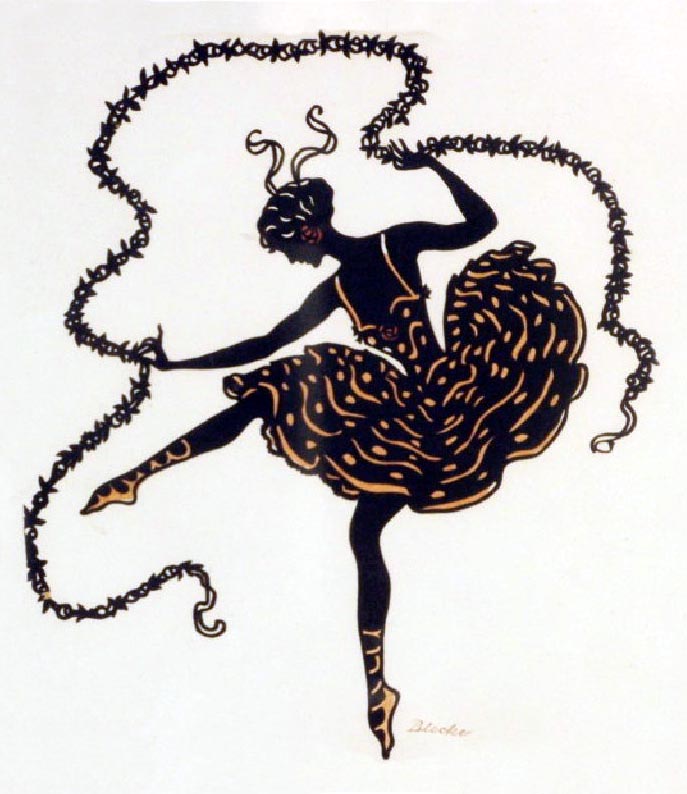
My eye was caught this month by a nice lot of four cut-paper silhouette pictures that were catalogued: "K.Kaskoune. A pair of early 20thC paper silhouettes and collage pictures and two similar pictures one inscribed "Blecke" 20 x 20cm". The auctioneers estimate was £40 to £80 for the group of four. Here are photos of two of them, copied and cleaned up from the dodgy originals in the online catalogue:


I liked them because they express so very clearly the spirit of the age in which they were created, the 1920's, often referred to as the "Jazz Age". I like the iconography of the period too, the distinctive style of dress and furniture, and the Art Deco stylisation of form in drawing with its use of Pierrot characters, or Cupid, who always seems to be in trouble for bringing love into flirtatious relationships.

In the event, the lot went for more than the top estimate, but for far less than I would have been prepared to pay. A bit of light web-searching showed that these cut-outs were by two significant practitioners of this art form. For example, a Blecke silhouette can be found in the Library of Congress collection and he is referred to in art dealers inventories. The attribution "K.Kaskoune" is interesting as it is clearly a mis-reading of the signature "F. Kaskeline", where the flowery K has been read as F and the capitalised ELI has been read as OU. An easy mistake to make with an unfamiliar name.

Here are the two remaining silhouettes in the set (as found):


My interest in these pictures was prompted because of the silhouette's significant place in the pre-history of photography. The shadow of a person cast on a surface had long been exploited as a way of making a simple likeness by tracing around it and filling it in. The sensitivity of silver salts to light was discovered by J.H. Schulze in the early eighteenth century, so it was a logical step for later photographic pioneers such as Tom and Josiah Wedgwood to attempt to use silver nitrate to make decorative silhouettes by the action of light. Though their experiments were ultimately unsuccessful, they provided an important stepping-stone in the evolution of the silver-based photographic processes that are still being used today.