Tuesday, 21 September 2010

Thoughts on a Box of Bricks


This little box of toy bricks I found in a local antique shop may have been only half-full, but I only really wanted the label on the lid. Despite being torn in half and held together by sellotape, the brightly coloured chromolith print had lots of attractive qualities.

There is a kind of law of inverse returns with these cheap toys which states that the meaner the contents of the box, the grander the depiction of the contents on the label will be. This shallow, 8" x 5" (20cm x13cm) box had only ten surviving bricks in it, with enough room to accommodate about six more. Fewer than twenty bricks is scarcely sufficient to begin work on the wonderful model in the picture. Still, the sense of exaggeration is part of its charm. I love the proud satisfaction of the builder as he shows it to the younger boy, who is reaching out to touch it and doubtlessly longing to knock it down! I also like the Alpine scenery in the background, setting the model in its proper rural context as a grand country villa. As there is no identifying text on the box or its contents, the label is all we have to suggest the toy's Germanic(?) provenance.

I haven't yet been able to come up with an explanation for the glaring error in perspective at the extreme left hand edge of the picture. The edge of the table leading away from the picture plane is completely at the wrong angle. Perhaps there was damage to the original artwork that needed retouching in the print shop. That might also account for the rather poorly-drawn  vertical band of yellow wall or curtain.

Sunday, 19 September 2010

Silhouettes and Photography


It's always good fun to look through catalogues of upcoming local auctions to see what goodies are coming up for sale. You can play the game of guessing which items will sell for peanuts and which will have bids running way beyond the auctioneer's estimate. I sometimes like to make a fantasy short-list of things I would bid for myself, though I'm seldom tempted into making actual bids.

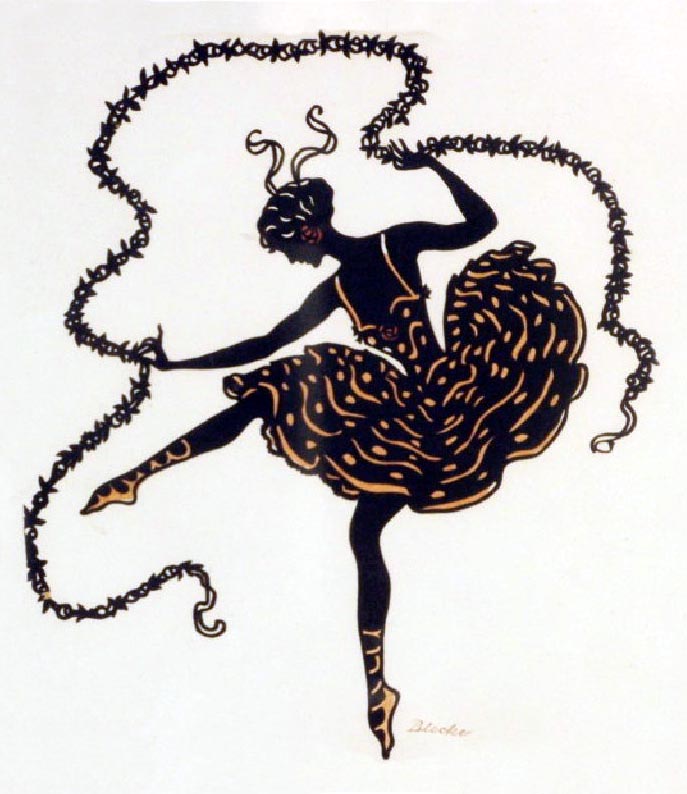
My eye was caught this month by a nice lot of four cut-paper silhouette pictures that were catalogued: "K.Kaskoune. A pair of early 20thC paper silhouettes and collage pictures and two similar pictures one inscribed "Blecke" 20 x 20cm". The auctioneers estimate was £40 to £80 for the group of four. Here are photos of two of them, copied and cleaned up from the dodgy originals in the online catalogue:


I liked them because they express so very clearly the spirit of the age in which they were created, the 1920's, often referred to as the "Jazz Age". I like the iconography of the period too, the distinctive style of dress and furniture, and the Art Deco stylisation of form in drawing with its use of Pierrot characters, or Cupid, who always seems to be in trouble for bringing love into flirtatious relationships.

In the event, the lot went for more than the top estimate, but for far less than I would have been prepared to pay. A bit of light web-searching showed that these cut-outs were by two significant practitioners of this art form. For example, a Blecke silhouette can be found in the Library of Congress collection and he is referred to in art dealers inventories. The attribution "K.Kaskoune" is interesting as it is clearly a mis-reading of the signature "F. Kaskeline", where the flowery K has been read as F and the capitalised ELI has been read as OU. An easy mistake to make with an unfamiliar name.

Here are the two remaining silhouettes in the set (as found):


My interest in these pictures was prompted because of the silhouette's significant place in the pre-history of photography. The shadow of a person cast on a surface had long been exploited as a way of making a simple likeness by tracing around it and filling it in. The sensitivity of silver salts to light was discovered by J.H. Schulze in the early eighteenth century, so it was a logical step for later photographic pioneers such as Tom and Josiah Wedgwood to attempt to use silver nitrate to make decorative silhouettes by the action of light. Though their experiments were ultimately unsuccessful, they provided an important stepping-stone in the evolution of the silver-based photographic processes that are still being used today.

Thursday, 9 September 2010

The Power of Images: the Making of an Icon


Sorting through a bundle of ephemeral scraps I'd brought back from my recent trip to Edinburgh and the Festival, I came across a page I'd torn from the Saturday Magazine supplement of the Scotsman. It was a listings page that contained a small (roughly 3cm square) photograph of Florence Nightingale.


(A number of programmes were broadcast during August to mark the centenary of her death)
Roland Barthes and others have written at length about the compelling power of photographs, but I was interested to know why I was drawn to this particular image.
The tight head-shot of a Victorian subject against a dark background immediately called to mind Julia Margaret Cameron's iconic images, though I knew that the photograph wasn't hers.
At that small scale, reproduction through a coarse dot screen gave the image a contrasty, Warhol-like, graphic arts quality. The semi-abstract reduction of the image to a matrix of dots is more apparent when the image is enlarged.
Primarily though, it is the quality of the character we read into the face that draws our attention, for it is the face of a woman whose life and achievements working for the public good have become legendary. Like the votive image of a saint, versions of this portrait now adorn everything from key rings and cushion covers to tee shirts.
It is a face that seems to signify goodness through its serene, self-confident expression and simple beauty — the simple beauty, that is, of someone who possesses regular features. She could well be seen as a Madonna, or the heroine of a story by the Brontés or Dickens. I liked it enough to wonder where the image came from.
There appear to be eight known photographs of Florence Nightingale in existence, and the source of this one seems to be a carte-de-visite photograph taken (probably) by Goodman of Derby.
The invention of the wet collodion photographic process in about 1851 gave photographers the opportunity to make good quality glossy albumen prints from glass negatives. These prints could be mounted onto card and sold.
Cartes of famous Victorians were published in large numbers for the public to collect and mark an important stage in the evolution of celebrity culture as we know it today. Although eminent Victorians recognised the value of promoting their image through photography, things did not always go smoothly. There is a story of Alfred Lord Tennyson's discomfort at being pestered in public by a stranger who recognised him from his photograph.
Having found the source of my newspaper image, I was intrigued by slight but significant differences between the faces in the cropped and original versions.
The red outline indicates the original height before vertical compression.
It's clear that the crop in the newspaper version has been tilted to make the head more upright. Interestingly, it has also been compressed vertically, which has the effect of making the eyes and mouth seem wider and the face more square. There has also been a significant amount of cosmetic retouching to make the facial features more defined, the lips fuller, the pupils larger and more limpid. In effect, she has had a make-over as good as any modern-day cover girl.
It would be interesting to find out when this enhancement took place. Although Victorian portrait studios employed retouchers to correct blurry eyeballs and remove disfigurements, I suspect that we are looking at a more recent attempt to glamourise this remarkable woman whose fame rests after all on her deeds rather than her looks.
While the manipulation of this particular photograph is clearly not something to get too bothered about, it does suggest that there may be ethical issues concerning the veracity of nineteenth century photographs as they are used by the mass-media today. The great power and strength of photography for the Victorians was its ability to hold up a mirror to the world and record what it reflected with utter truthfulness. It is a pity if we are to see such honesty treated too casually.

Tuesday, 31 August 2010

Fernand Léger and Normandy, Footnote to a Summer Holiday


Pinned to the living room wall of our rented cottage in Saint Julien de Mailloc was this rather faded poster.

Although it showed a painted image, it was only after a few days that I realised that the painting was not the entire image but only the decorative element in a tightly cropped photograph. Most of the detail that would give clues to the scale and context of the painting were excluded, but I suddenly realised that the chevron shape at the top was the gable end of a roof and the band of faded green across the bottom of the image was vegetation.

Although Léger had been a hero, influence and inspiration to me in my student days, I had no idea that we were holidaying in his native countryside, where he returned to live out his final years. Having travelled to France without computers, and with no wi-fi, we were without the means to do an online search for information, so were left in ignorance of the image's significance.

The text on the poster gave the location of the village, so it was easy enough to plan a slight diversion on the next day's trip to the pretty town of Liseux. The winding back roads that took us to Lisores were a delight in themselves as they meandered through fields and orchards sleeping in the Summer sunshine. The village communities in this part of France seemed spread out, like our own village of Saint Julien de Mailloc. Their centres seemed relatively small, little more than hamlets, but with large numbers of outlying small farms. Lisores was no exception, and seemed to be a pretty little community on a steep hillside, scattered around a modest little church. While there, we were sufficiently intrigued by an extravagantly oversized mausoleum in the churchyard to stop and take a look.


There were no signs or clues in the village showing us where to find the building on the poster, nor anyone around in the midday heat to ask. With two small restless boys in the back of the car impatient to get to the swimming pool in Liseux, it was time to abandon mission and press on.

However, my interest in Léger has been revived and I've since been able to find out the significance of Lisores. He was a local man and it would seem that the property was a family farm he inherited. He may have moved there briefly in 1940 following the German invasion of France before emigrating to the USA. He returned to France and Paris after the war and seems to have moved out to Lisores in the final years before his death in 1955. I can't be at all precise with the biographical details as the online sources I've used contradict each other in significant ways. Clearly, more thorough research is needed if one is to get a clearer picture of the part that Normandy and the farm at Lisores played in his life.

What my online searches do show is that we might have been disappointed if we had found the farm. At the time of the poster it was a museum, but it seems to have closed in the 1980's. Alexia Guggémos's Delire de l'Art blog posting in 2008 warned of the decay and dilapidation that was overwhelming the property:


"Elle n’est plus que ruines ! Le panneau indicateur qui y conduit est rongé par les mousses, le chemin d’accès envahi d’herbes folles, la maison elle-même perdue dans les ronces et les orties. Du portail, on aperçoit juste sa façade colorée, encore magnifiquement ornée d’une fresque de l’artiste. La seule qui ait survécu. Tout le reste n’est qu’éventration et massacre."

(It is in ruins! The sign pointing the way to it is eaten away by mosses, the path is overgrown with weeds, the house itself lost in brambles and nettles. From the gate you can see just the coloured facade, still beautifully decorated with a fresco by the artist. It is the only thing that has survived. Everything else is torn out and destroyed.)

More recently, a piece on the Ouest-France website in December 2009 paints a more hopeful prospect for the future. It is apparently being restored by its present owner, art dealer Jean du Chatenet, who plans to reopen it as a cultural centre by 2012.


La ferme musée Fernand-Léger pourrait rouvrir dans deux ans
Lisores
Mercredi 30 Décembre 2009

It seems a shame that the world at large seems to have neglected this aspect of Légers's legacy. Though M. du Chatenet's plan cannot bring back what decay and depredation have taken away, it should at least preserve and give new life to what is left. We must wish him every success in his ambitious venture.

Thursday, 19 August 2010

Edward Weston in Edinburgh

While passing through Edinburgh at Festival time, I couldn't miss the opportunity to take a look at the Edward Weston exhibition. It takes up two floors of the City Art Centre, in Market Street and according to the exhibition leaflet, is the largest show of his work ever to visit the UK. The aim is to present a survey of his career and the work is grouped into sections that illustrate the development of his style in relation to his varied subject matter.

Pepper No. 30. 1930

Given that most of us know his work through reproductions in books, there's a certain frisson to seeing original vintage prints, sometimes signed and sometimes coming ever-so-slightly detached from their faded mounts. As well as the still life photographs that we're so familiar with, there were sections devoted to his work in Mexico, his portraits, nudes and early and later landscapes.

There were a fair number of images that are not generally known, especially among the portraits and early work. Seen alongside the better known works, they were key to showing how the stylistic conventions of his more celebrated work developed. The essence of the Edward Weston look.

'The White Iris' (Tina Modotti)
(This photograph was not in the exhibition)

A surprising (partial) omission was the scarcity of images relating to his relationship with Tina Modotti. The influence of Tina Modotti and Margrethe Mather in causing Weston to abandon his wife and conventionality in favour of bohemianism is key to both his oeuvre and his subject matter.

Edward Weston and Margrete Mather, 1922
(photo by Imogen Cunningham, not in exhibition)

The emphasis seemed to be on his later involvement with Charis Wilson, who both inspired him and gave him the practical help he needed to build a wider reputation and create much of the work for which he is now remembered. A hour-long documentary playing in a side gallery of the exhibition explored this phase of his career. It was too long a film to sit through for the majority of visitors, who mostly glanced in and moved away. As a day-tripper myself, I could only give it ten minutes or so of my time — it's unrealistic of exhibition organisers to expect visitors to do more, especially at Festival time. In this wired world, there should be other ways of accessing this kind of supporting material for visitors who want to learn more. It's surely possible for it to be made available online or via digital TV, if necessary via a secure password issued with the entry ticket.

Anyway, it was an enjoyable and memorable exhibition, the first big Weston show I've seen since the V&A show back in the early 1970's. Glad I saw it, though I couldn't afterwards summon up the willpower or a strong enough stomach to spend more than a token few seconds with William Wegman's bizarre dressed-up doggy pictures on the top floor. I still not quite sure whether I don't get his work, or whether I get it too well.

The Edward Weston exhibition continues at the City Art Centre until the 24th October 2010.

LABLOG

LABLOG


A cool-looking noise-generator / instrument. Make one yourself at the Dirty Electronics Weekend Laboratory, Nottingham. 18th-19th September.


Skull Etching from Dirty Electronics on Vimeo.

Saturday, 17 July 2010

Life in Motion


The Summer holiday provides a welcome opportunity to reflect on the year so far and perhaps to make plans for the future. As I look back over undeveloped notes for this blog, I find a few notes that seemed important when I made them, but which now puzzle me as I try to understand what I was really trying to say. Here's a diagram I made that clearly meant something at the time:


The notes on the same page as this diagram seemed to be dwelling on the theme of the roots we put down and how strong they may or may not be. Many of us lack the depth of rootedness that earlier generations had. Older age and youth are both periods in life in which one undergoes marked changes in a relatively short period of time. In a culture that is driven by the search for new uses for technology and the systemic obsolescence of current technology, it can be difficult to maintain a sense of personal stability in one's life in order to cope with growing up or growing older.

Tuesday, 30 March 2010

Filling those short winter days

An evening by the peat stove, Locheport, February 2010

Curious that life has been so full of activity recently that this blog, which should log those events falls by the wayside for me as a tool to reflect on the passing scene. Perhaps now that the Easter break is almost upon us, there will be an opportunity to collate and comment on the amassed material.

Sunday, 28 February 2010

A Sense of Movement


The dramatic wintry weather we've endured since mid-December has acted as a marker or way-point, not only separating the old 2009 from the new 2010, but also acting as a full-stop to the decade known as the 'noughties'. Oh that the first years of the new century would have been filled with more naughtiness and fun! Was ever a decade less appropriately named?

Still, Mother Earth trembles silently beneath our feet. Like riding an elevator in motion, we know that movement is taking place though we appear to be standing still.

Sunday, 31 January 2010

Memories of Lammermuir

Footbridge across to Fast Castle, Berwickshire

A month has now passed since we parted company in Saint Abbs and life has resumed its daily cycle. However, like a wheel turning, each revolution takes us onto new ground. Two thousand and ten remains a prospect still full of optimism. The brighter, milder weather that's followed the bitter snows of January carries with it the promise of spring and opportunities for positive action.

It's certainly been a busy month work-wise, having to turn out every day and putting in more hours than some full-time colleagues. The benefit of long hours is seen in my monthly payslip, but the corresponding downside is evening exhaustion. The weekends become so much more precious as a resource. Projects beckon and time has to be so much more carefully managed.

In quieter moments, my imagination has been captured by the Bride of Lammermoor, Walter Scott's tragic tale of madness, oppression and thwarted love. Not an author I ever thought I would be likely to read, I came to his gothic tale via Donizetti's operatic adaptation Lucia di Lammermoor, which in turn I originally discovered many years ago via the soundtrack of Paul Cox's 1973 comedy-drama, Man of Flowers. (One of my all-time favourite films, not least for the way it visualises memory in the flashback sequences.) The Christmas holiday provided the opportunity for my third visit to Fast Castle, the first visit in which I began to understand its relevance to Scott's tale.

Every time I've visited the place, lonely and remote though it is, I've always been surprised to find other people there. One curious thing is that they never look like the kind of people you would ever expect to find in such a God-forsaken spot, the sort that Florence (who was with me again this time) calls "ruff-ty tuff-ty". On this, the bitterest, bleakest day you could ever have wished to stay indoors, we found there a minibus-full of dapper twenty-somethings, dressed alike in smart urban clothes. They were leaving as we approached, so we never got to talk, but never did a group look so out of place as they set off back to their minibus, parked two or three miles away down a snowbound lane. My theory is that they were there because of the Scott/Donizetti connection and might have been musicians or singers absorbing the atmosphere. Whoever they were, seeing them there was a slighty surreal experience.

There are so many brilliant performances from Lucia that it's impossible to choose the definitive one. Joan Sutherland for the voice - or the acting of Natalie Dessay? What about Netrebko? Caballé? YouTube has Dessay's entire mad scene split into parts 1 to 3. Mesmerising and so worth watching!

Wednesday, 30 December 2009

Chilling (Out of Signal)


It seemed like such a good idea at the time – to meet up for a family Christmas at a midway point. No-one could remember the last time we all spent Christmas together as a family. Someone was always needed elsewhere.

Saint Abbs, ten miles North of the Scottish border, seemed to be the perfect location. More or less three hundred miles equidistant for those who lived furthest apart, North and South.

It suddenly seemed far less attractive a proposition a few days before we were due to arrive as the weather closed in. Everyone would need to make their journey in some of the most difficult driving conditions that the British weather can throw at you.

For me, a mere two hundred and fifty mile drive straight up the Great North Road (A1) is always something special. It has its own particular, slightly epic, quality with so much history and a magical landscape lining the road on either side.

Monday, 30 November 2009

New Experiments

It's been a very busy second half to the Autumn Term. First Year National Diploma students keen to experiment with lots of unfamiliar techniques. They used an old Jessops Powerflash motordrive head (MD400) to strobe with their camera shutters open on B. There were the inevitable problems of overexposure sometimes when the subject didn't move far enough between flashes. I showed them how to produce a similar effect by using a motordrive to take a rapid sequence of single frames which could be layered in Photoshop and selectively blended to create a strobe-like composite image. The shot above was the first attempt. With care, I'm sure some really nice sequences could be made.


A few of the students were curious to know about HDR (High Dynamic Range) photography, though none knew what it was. I decided to demonstrate in class, using as an example two of the students who were taking a break near the window. It was fairly late on a very dull November day and the room lights were on. With the digital camera steady on a tripod, I asked the girls to remain very still while I took two shots, one metered for them, the other metered for the scene outside. The two images are shown at the top, with burnt-out highlights coloured red and textureless shadows coloured blue.

Again, I layered them in Photoshop with the indoor shot uppermost. I then carefully erased the window in this layer to expose the background scene of the lower layer. The hair was the trickiest part and there was a slight mis-registering between the layers to cope with. So, it's not perfect but I'm quite pleased with it as my own first attempt to have a go at this technique.


Another technique I've been trying to get students interested in, is pushing photograms beyond the familiar arrangements of keys and coins and other everyday items. Charity shops always have shelves of ornamental items such as the glass bowls I used for these images. Scanning the photogram and manipulating it in Photoshop, I was able create some psychedelically coloured animated .gifs.


The enlarger I used to make these photograms was in a pretty filthy condition, as I found out when I took the prints out into the daylight. The black background was covered in thousands of tiny dust specks. In this photogram, though, they looked like a myriad tiny stars, blinking away behind a baleful planet hanging there in a vast space. It seemed a logical step to colourise the scan to enhance this illusion and to add some random coloured shaped to create an imaginary perspective.


Lots of other creative ideas are developing. Having just repaired our UV exposure unit, I'm ready to roll again on cyanotypes and salt prints (always a favourite with students). Parts for an infra-red and a sound flash trigger are sitting on my workbench. And then there's stop motion animation and stereoscopic photography . . .