Sunday, 30 January 2011

The Darkroom is not Dead Yet

Every generation experiences it — materials and working methods being rendered obsolete by newer technologies and processes. It's been a fact of life for most of us since the early twentieth century, and in some trades since the dawn of the Industrial Revolution. Craft skills vital to Victorian and early twentieth century economies have all but died out, sustained only by hobbyists and determined individuals running niche businesses catering to specialised micro-markets.

Those of us who are antique enough to have lived through photography's transition from a  film-based activity to a digital process may still feel nostalgia for the the processes and procedures needed to produce finely-crafted prints in a darkroom.

Much as I enjoy producing digital prints, they lack a certain something in terms of the relationship I have with them and the sense of satisfaction I get from creating them. There is a tactile disconnection in the sense that the images seem manufactured rather than hand-crafted. They are processed behind the glass wall of the monitor screen and printed out by the computer for me, rather than by me. It can be hard to feel the same sense of ownership of the finished work that you get from making an image appear through the action of light and chemicals on materials you control with your hands.

This pleasure of making an image by hand is clearly still a real one for many of my students, especially when they are given an opportunity to work with the older processes, such as cyanotypes. There is also a lot of instructive pleasure to be had from improvising with obsolete cameras, using photo-paper negatives cut to size and inserted in the back of the camera in place of the original paper-backed roll of film. Box cameras are particularly good for this, having a distinctive image quality that more modern cameras cannot, and would not want to, replicate (Lomo's and assorted Hipstamatics excepted). Wanting to push this experimental activity a little further, it seemed a good idea to test how far down the path of image quality we could go by increasing the size of the negative.

The camera we have been using is a clapped-out large format Linhof, with no lens and a cracked ground-glass screen. I fashioned a lens board from black foam board to take a 103mm lens borrowed from a medium-format Graflex Century Graphic folding camera. Although the image circle of the lens barely reaches the corners of the 5"x 4" negative, the vignetting effect it gives is in itself quite evocative of early photographs.

Street scene, Lincoln.      Photo by Daniel L.
This is an early attempt, made by a student outside in the street on a scrap of accidentally fogged photo paper, while he was getting to grips with loading the paper into darkslides and determining the optimum exposure time. The paper he was using was Kentmere Bromide non-resin-coated Grade 2, developed in ordinary print developer. In my experience, variable-contrast paper is excessively contrasty when exposed to daylight, something I put down to the blueness of the light. As in the darkroom, using a yellow filter softens contrast but stretches an already lengthy exposure time.

Hayley and Joe by the Bail Wall      Photo by Daniel L.
Once exposure times had been arrived at by trial and error, the student embarked on producing some more considered images. This one, of two of his fellow students, was taken against the outer bail wall, in the grounds of the Bishop's Palace.

Composite Portrait of H. and J. by Daniel L.
This is a double portrait of the two students in the picture above. Dan told me that he positioned his subjects using their eyes as the reference point to get the two exposures in register. I find the end result strangely compelling yet unsettling. The image is somehow uncanny – a composite face that is not so much a face, but rather the idea of a face. It has something of the quality of the nineteenth-century photographic experiments of Francis Galton or Arthur Batut.

This is clearly a potentially fruitful subject for further experimentation.

Postscript: The photographs were added to this post in December 2011, although they were taken at the time of the original post. The experiments have been revived with different materials.
There was an interesting article in the Guardian last Christmas on the disappearing commercial darkrooms of London. Note the link to a related video in the article's sidebar. It's worth watching.

Monday, 20 December 2010

Beach Café under Snow


Midday weather forecast today like something off Fast Show. Everywhere 'Siberio' for the forseeable future.

Friday, 3 December 2010

Imogen Heap, Ellipse and Involuntary Memory

Until recently, Imogen Heap was just another celebrity name that meant little or nothing to me. After all, so many names keep appearing that you just can't keep track. However, her name came up recently while I was browsing Zoe Keating's website. In the Bio section, Zoe said she had worked with Imogen so I thought she must be worth looking up.

A link on the main page of Imogen Heap's website takes you to her YouTube channel, where among other goodies is the fascinating official video of  'First Train Home', the first track on her most recent album, 'Ellipse'. 
It's an elegantly constructed production that starts with Imogen's character trapped in a seemingly endless pillared corridor or loggia peopled by partying out-of-focus city types.
As she runs, looking to escape, the pillared walls morph into a wheel of life, a zoetrope, being turned by a larger version of herself. The whole thing has the absurd but relentless logic of a nightmare.
There's one moment in this visually attractive and inventive film to which I find myself unaccountably drawn. It occurs at two minutes in, when the running Imogen slows and pauses mid-stride, like a winding down automaton, to gaze upwards in astonishment at what we learn will be her larger self. It's a 'whoaa!' moment as she leans back in a perfect expression of awe.
Composite (cropped) screen grabs of consecutive frames
As the moment flashes by, I'm immediately looking at another image in my mind. A picture whose exact character still eludes me. I see it and I sense it, but I haven't yet been able to make it tangible. What is the image this moment irresistibly reminds me of?
What I seem to see in my mind's eye is an illustration. It is a frame perhaps from a bande dessinee – a European comic strip or graphic novel – in which the hero has a moment of revelation. It could be the memory of a drawing by Moebius (Jean Giraud). His characters also inhabit a world full of wonderful contradictions of scale.

Perhaps Imogen's baggy pants are a subliminal reference to Hergé (George Rémi), whose hero Tintin wore similar trousers while dashing about on a variety of urgent missions. Who knows?
Much as I've scoured my books, my brain and the web, the precise memory of the original image still refuses to surface. All I know is that one day I will be likely to see again the image that today eludes me and a tiny circle of past and present experience will have been completed.

"And suddenly the memory revealed itself: The taste was that of the little piece of madeleine which on Sunday mornings at Combray … my aunt Léonie used to give me, dipping it first in her own cup of tea or tisane."
Remembrance of Things Past, Marcel Proust.

Sunday, 14 November 2010

Artemis, aka Diana: Mad, Bad and Dangerous?

Just the other day, I posted to Flickr a cyanotype print (blueprint) that I'd made to test a fresh batch of chemicals. To make it I used a photocopy on acetate of a nineteenth-century engraving of a statue. It's the kind of hand-cut engraving that was used by printers before photographically-generated half-tone images were introduced in the 1880s.

I use it as a test image to see how much fine detail is recorded by the cyanotype. The quality of the engraving is superb. It captures both the modelling of the three-dimensional form and the tonal range of the wet collodion/albumen print from which it was undoubtedly copied.

However, one can't help but be interested in the subject of the print as well. It's a statue of an attractive young woman who is strikingly, but negligently, dressed. One of her breasts is uncovered and her hitched-up chiton blows in an unseen breeze that wraps it revealingly around her legs and  the other breast. It's an image that is as seductive as it is graceful.

The bow she carries and the dog by her side identify it as a generic representation of the goddess Artemis in her Roman form as Diana. To find out a little bit more about this  ancient super-woman, I looked her up in my paperback copy of Ovid's Metamorphoses. Hmmm, not a woman to be tampered with.


Poor Actaeon, a mere mortal, wandering through the woods one day while out hunting, stumbled upon her and her consort of adoring nymphs bathing in a stream. Ovid tells us she was so affronted at being caught without her kit on that she splashed water on him while uttering a terrible curse that turned him into a stag. The poor lad, distraught at his transformation, ran off to try and find his friends but met his own hunting dogs who, not recognising him, set upon him and tore him to pieces. The above painting by Titian shows the fateful moment he glimpses Diana au naturelle. The painting below, also by Titian, shows Diana even more vindictively sticking an arrow into the partially transformed Actaeon.
The Death of Actaeon          source: Wikipedia

This was not the only time Diana revealed the harsh side of her nature. Her favourite nymph, Callisto, came to a tragic end through no fault of her own. She was fancied by Jupiter, who seduced her by disguising himself as Diana. The pregnant Callisto was cruelly rejected by the real Diana and after having Jupiter's child, was turned into a bear by Jupiter's jealous wife Juno. When her child, Arcas, had grown, he met his mother while out hunting. Not recognising who she was, he was about to shoot her when the penitent Jupiter averted tragedy by lifting them together to heaven to form the constellation of the Great Bear, Ursa Major.

I won't go into the incident of the wild boar Diana let loose in a fit of temper, except to say it caused havoc, destruction and death before it was finally killed.

These ancient yarns are an extraordinarily heady mix of unrestrained sex and violence in all their different forms. They provide Queer Theory with a wonderfully fertile subject for study.

source: wikipedia

Myself, I merely wonder why, given Diana's objection to be seen unclothed, artists and sculptors have always delighted in depicting her at least semi-naked. What's the sub-text to this? I'd like to think there's an element of payback for the murderous spite she showed to poor old Actaeon.


Ovid: Metamorphoses, translated with an introduction by Mary Innes.
(Penguin Classics series, first published 1955)
Harmondsworth, UK. Penguin Books.

Saturday, 13 November 2010

Captain Ska's 'Liar Liar'

It would be great to think it could become the Christmas Number One. There's a campaign to get it there, though there's still a long time to go and it lacks the usual warm and fuzzy feel-good factor. There's nothing I can say about the message of the song that the video doesn't say better:


It's great to hear ska music asserting once again its rightful role as an authentic musical voice of political activism. It's reminiscent of the days of Free Nelson Mandela, Ghost Town, etc.

Almost more than my horror at the coalition's destruction of the welfare state, I was appalled to learn of the Liberal Democrat leadership's cynical betrayal of young voters, revealed in the Guardian today:
'Lib Debs planned before election to abandon tuition fees pledge'.
Commenting on the article, redskyinthewest summed up my feelings for Clegg exactly:
Shame on him! I am a student and my politically apathetic student friends turned to me and said 'you know what, i'm going to vote for this guy', first timer voters really believed in him, I saw so many new youngsters becoming interested and even involved in politics because of the hope this man gave, and he's just gone and sh**ted all over them. Shame on him!
Clegg has done more than any previous politician to single-handedly destroy the public's faith and trust in the value of casting their votes. And this at a time when unprecedented public apathy and cynicism towards politics is rightly condemned. Thank God my vote didn't help put him in power, or I'd be really mad!

Tuesday, 9 November 2010

Zoe Keating: 'Into the Trees'

Delighted to see Zoe Keating has a new album – at least it was new when it came out in July. I get so out of touch sometimes.


As with her other two albums, it's going to be well worth splashing some cash on if the track 'Optimist' is anything to go by.  Listen here: http://www.zoekeating.com/projects.html.

I still find the video of her first appearance at Pop!Tech in 2007 mesmerising. It was the first time I'd come into contact with her work. One of my few regrets since then is that I've always missed her far-too-few appearances in the UK.


Sunday, 31 October 2010

Diane Arbus at Nottingham Contemporary

Earlier this month, I paid my first visit to the new Nottingham Contemporary to catch the tail-end of the Diane Arbus exhibition. This exhibition is one of the Artist Rooms circulating shows and will be shown at Aberdeen Art Gallery and Tate Modern early in 2011.


This is not reversed, the signage has been painted that way
Nottingham Contemporary is very conveniently located only a few yards away from the upper level exit from the Broadmarsh Shopping Centre. It is a curious-looking building. Whatever delights it may contain in the way of exhibitions, the building itself has an aggressive, forbidding exterior. Its relatively windowless outside walls are painted a drab camouflage green, making it look like a casemate or fortified gun emplacement. One could well imagine that it would look quite at home along the Maginot Line or among the World War II defences of the Normandy Coastline. Like those structures, it is a multi-level building built down into the ground, descending into a disused railway cutting where the old Great Central Railway once entered a tunnel that burrowed deep beneath the heart of the city. 

Maybe it's my ageing eyesight, but I completely missed the main entrance, which is part of the long glass wall beneath the overhang in the lower photograph. Having walked straight past it without seeing that one part of the glass wall was a door, I went down the outside stairs to a patio outside the lower level. There, I could get into the gallery café and up the inside stairs to the main exhibition area.

Once inside the gallery, the exhibition lived up to all the positive reports I'd heard from the students who had already been to see it. Given that her work is so well-known, there is little I feel I can add except to note the pleasure of looking at first-generation and vintage prints of images usually seen as reproductions in books. The classic images we know so well – the identical twins and the boy with the hand grenade – were all there alongside a wealth of images that give an idea of a much broader range to her work.

While all of her work draws our attention to what the exhibition leaflet calls 'the unusual in the ordinary', many of her photographs avoid an emphasis on the grotesque and freakish and 'reflect her broader interest in the rituals and customs of self-contained groups'. In this, it is easy to see the inspiration she drew from the documentary portraiture of August Sander, whose influence she readily acknowledged. 

It was an exhibition that would repay a second visit, so it will be a pleasure to go and see it when it travels to London in March alongside what should be an equally fascinating exhibition on the work of Joseph Beuys.

Wednesday, 27 October 2010

Stuff that Dreams are made of

The wackiest circuit diagram - ever!

Thanks xkcd for giving this to the world. Nice to see an Arduino in there to keep things under control.
I wonder if Velleman, MUTR, Adafruit or anyone is up to doing it as a kit?

Meanwhile, I think the Graffiti Research Lab have a simpler way to use up our surplus leds:


Whatever you do, it's important to stay safe and wear protective clothing, such as the Snorg tee shirt that carries this message:

Tuesday, 21 September 2010

Thoughts on a Box of Bricks


This little box of toy bricks I found in a local antique shop may have been only half-full, but I only really wanted the label on the lid. Despite being torn in half and held together by sellotape, the brightly coloured chromolith print had lots of attractive qualities.

There is a kind of law of inverse returns with these cheap toys which states that the meaner the contents of the box, the grander the depiction of the contents on the label will be. This shallow, 8" x 5" (20cm x13cm) box had only ten surviving bricks in it, with enough room to accommodate about six more. Fewer than twenty bricks is scarcely sufficient to begin work on the wonderful model in the picture. Still, the sense of exaggeration is part of its charm. I love the proud satisfaction of the builder as he shows it to the younger boy, who is reaching out to touch it and doubtlessly longing to knock it down! I also like the Alpine scenery in the background, setting the model in its proper rural context as a grand country villa. As there is no identifying text on the box or its contents, the label is all we have to suggest the toy's Germanic(?) provenance.

I haven't yet been able to come up with an explanation for the glaring error in perspective at the extreme left hand edge of the picture. The edge of the table leading away from the picture plane is completely at the wrong angle. Perhaps there was damage to the original artwork that needed retouching in the print shop. That might also account for the rather poorly-drawn  vertical band of yellow wall or curtain.

Sunday, 19 September 2010

Silhouettes and Photography


It's always good fun to look through catalogues of upcoming local auctions to see what goodies are coming up for sale. You can play the game of guessing which items will sell for peanuts and which will have bids running way beyond the auctioneer's estimate. I sometimes like to make a fantasy short-list of things I would bid for myself, though I'm seldom tempted into making actual bids.

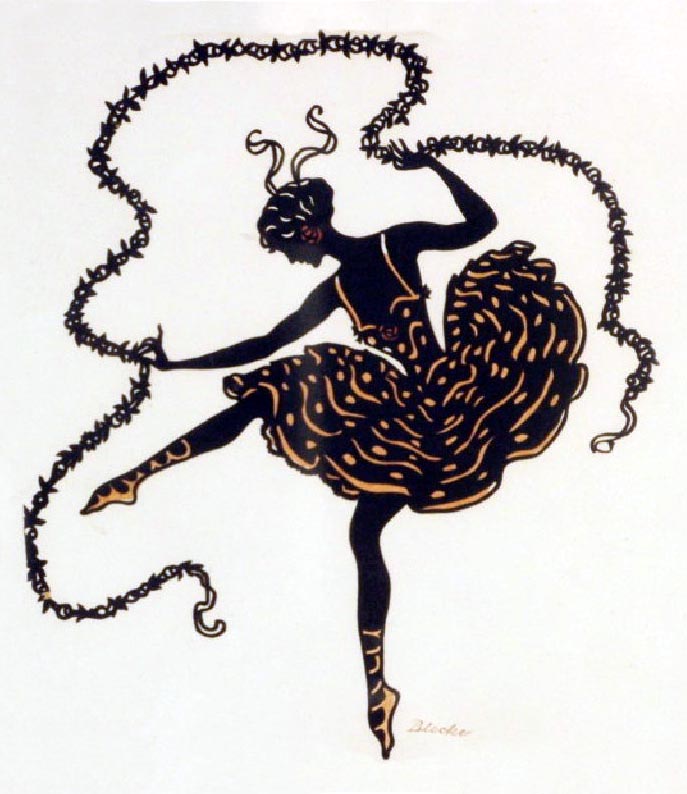
My eye was caught this month by a nice lot of four cut-paper silhouette pictures that were catalogued: "K.Kaskoune. A pair of early 20thC paper silhouettes and collage pictures and two similar pictures one inscribed "Blecke" 20 x 20cm". The auctioneers estimate was £40 to £80 for the group of four. Here are photos of two of them, copied and cleaned up from the dodgy originals in the online catalogue:


I liked them because they express so very clearly the spirit of the age in which they were created, the 1920's, often referred to as the "Jazz Age". I like the iconography of the period too, the distinctive style of dress and furniture, and the Art Deco stylisation of form in drawing with its use of Pierrot characters, or Cupid, who always seems to be in trouble for bringing love into flirtatious relationships.

In the event, the lot went for more than the top estimate, but for far less than I would have been prepared to pay. A bit of light web-searching showed that these cut-outs were by two significant practitioners of this art form. For example, a Blecke silhouette can be found in the Library of Congress collection and he is referred to in art dealers inventories. The attribution "K.Kaskoune" is interesting as it is clearly a mis-reading of the signature "F. Kaskeline", where the flowery K has been read as F and the capitalised ELI has been read as OU. An easy mistake to make with an unfamiliar name.

Here are the two remaining silhouettes in the set (as found):


My interest in these pictures was prompted because of the silhouette's significant place in the pre-history of photography. The shadow of a person cast on a surface had long been exploited as a way of making a simple likeness by tracing around it and filling it in. The sensitivity of silver salts to light was discovered by J.H. Schulze in the early eighteenth century, so it was a logical step for later photographic pioneers such as Tom and Josiah Wedgwood to attempt to use silver nitrate to make decorative silhouettes by the action of light. Though their experiments were ultimately unsuccessful, they provided an important stepping-stone in the evolution of the silver-based photographic processes that are still being used today.

Thursday, 9 September 2010

The Power of Images: the Making of an Icon


Sorting through a bundle of ephemeral scraps I'd brought back from my recent trip to Edinburgh and the Festival, I came across a page I'd torn from the Saturday Magazine supplement of the Scotsman. It was a listings page that contained a small (roughly 3cm square) photograph of Florence Nightingale.


(A number of programmes were broadcast during August to mark the centenary of her death)
Roland Barthes and others have written at length about the compelling power of photographs, but I was interested to know why I was drawn to this particular image.
The tight head-shot of a Victorian subject against a dark background immediately called to mind Julia Margaret Cameron's iconic images, though I knew that the photograph wasn't hers.
At that small scale, reproduction through a coarse dot screen gave the image a contrasty, Warhol-like, graphic arts quality. The semi-abstract reduction of the image to a matrix of dots is more apparent when the image is enlarged.
Primarily though, it is the quality of the character we read into the face that draws our attention, for it is the face of a woman whose life and achievements working for the public good have become legendary. Like the votive image of a saint, versions of this portrait now adorn everything from key rings and cushion covers to tee shirts.
It is a face that seems to signify goodness through its serene, self-confident expression and simple beauty — the simple beauty, that is, of someone who possesses regular features. She could well be seen as a Madonna, or the heroine of a story by the Brontés or Dickens. I liked it enough to wonder where the image came from.
There appear to be eight known photographs of Florence Nightingale in existence, and the source of this one seems to be a carte-de-visite photograph taken (probably) by Goodman of Derby.
The invention of the wet collodion photographic process in about 1851 gave photographers the opportunity to make good quality glossy albumen prints from glass negatives. These prints could be mounted onto card and sold.
Cartes of famous Victorians were published in large numbers for the public to collect and mark an important stage in the evolution of celebrity culture as we know it today. Although eminent Victorians recognised the value of promoting their image through photography, things did not always go smoothly. There is a story of Alfred Lord Tennyson's discomfort at being pestered in public by a stranger who recognised him from his photograph.
Having found the source of my newspaper image, I was intrigued by slight but significant differences between the faces in the cropped and original versions.
The red outline indicates the original height before vertical compression.
It's clear that the crop in the newspaper version has been tilted to make the head more upright. Interestingly, it has also been compressed vertically, which has the effect of making the eyes and mouth seem wider and the face more square. There has also been a significant amount of cosmetic retouching to make the facial features more defined, the lips fuller, the pupils larger and more limpid. In effect, she has had a make-over as good as any modern-day cover girl.
It would be interesting to find out when this enhancement took place. Although Victorian portrait studios employed retouchers to correct blurry eyeballs and remove disfigurements, I suspect that we are looking at a more recent attempt to glamourise this remarkable woman whose fame rests after all on her deeds rather than her looks.
While the manipulation of this particular photograph is clearly not something to get too bothered about, it does suggest that there may be ethical issues concerning the veracity of nineteenth century photographs as they are used by the mass-media today. The great power and strength of photography for the Victorians was its ability to hold up a mirror to the world and record what it reflected with utter truthfulness. It is a pity if we are to see such honesty treated too casually.